
Precision in China Impeller Casting: Advanced Techniques for High-Performance Pump Components
¡Me encanta tenerte aquí! Antes de profundizar en el contenido, me encantaría que me acompañaras en mis redes sociales. Es donde comparto información adicional, conecto con nuestra increíble comunidad y te mantengo al tanto de las últimas noticias. Así es como puedes mantenerte conectado:
📘 Facebook: Shanghai Leierwo Industria Comercio Co., Ltd.
¡Ahora, emprendamos este viaje juntos! Espero que el contenido aquí te resulte no solo revelador, sino también inspirador y valioso. ¡Comencemos!
Tabla de contenido
Conclusiones clave
- Discover why China impeller casting has become a major solution for global pump manufacturing.
- Learn how precision casting improves pump efficiency, corrosion resistance, and service life.
- Understand the differences between investment casting, sand casting, and CNC machining.
- Explore material selection standards for chemical, marine, mining, and water treatment industries.
- Compare stainless steel, duplex steel, bronze, and alloy steel performance in pump applications.
- Review industry standards, inspection methods, and quality control systems used in precision casting.
- Learn how advanced simulation software and AI-assisted manufacturing improve impeller performance.
- Find practical answers to common buyer questions in the FAQ section.
Introducción
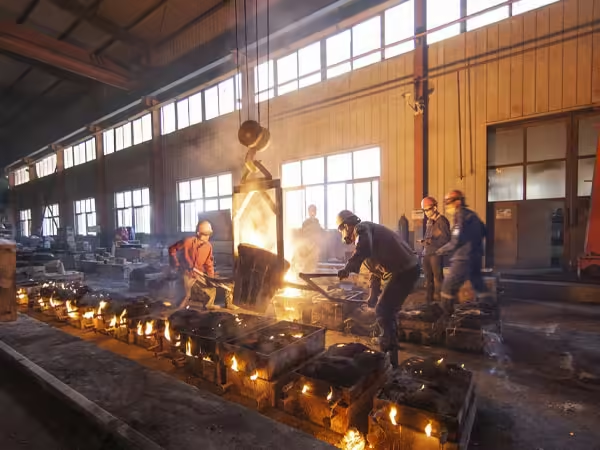
In today’s industrial world, pumps are essential to nearly every sector, including oil and gas, mining, chemical processing, desalination, wastewater treatment, marine engineering, food production, and power generation. At the center of every pump system lies one critical component that directly determines flow efficiency, pressure stability, energy consumption, and operational reliability: the impeller.
As industrial systems become more advanced, the demand for high-precision pump components has increased significantly. This is where China impeller casting has gained global recognition. Chinese casting manufacturers have evolved from low-cost suppliers into highly specialized precision engineering partners capable of meeting strict international standards.
moderno China impeller casting facilities now integrate:
- Investment casting technology
- CNC precision machining
- 3D mold simulation
- Metallurgical analysis
- Automated inspection systems
- Dynamic balancing technology
- Heat treatment optimization
These capabilities allow manufacturers to produce highly complex impellers with exceptional dimensional consistency and superior fluid dynamic performance.
According to recent global pump industry reports, the industrial pump market is expected to exceed USD 95 billion by 2030, with energy-efficient centrifugal pumps representing one of the fastest-growing segments. Because impellers directly influence hydraulic efficiency, precision casting has become a strategic manufacturing priority worldwide.
This article explores the technologies, materials, standards, production methods, and future trends behind modern China impeller casting, helping buyers, engineers, and industrial decision-makers better understand how precision casting improves pump performance and long-term reliability.
The Importance of Precision in China Impeller Casting
Why Impeller Accuracy Matters
The impeller functions as the rotating heart of a pump. It converts mechanical energy into fluid movement by accelerating liquids through specially designed blades.
Even minor dimensional deviations can cause:
- Reducción de la eficiencia hidráulica
- Increased turbulence
- Higher energy consumption
- Vibración excesiva
- Premature bearing wear
- Daño por cavitación
- Flow instability
Precision casting ensures that the impeller maintains optimized blade geometry and balanced rotational performance.
The Relationship Between Precision and Pump Efficiency
Research from hydraulic engineering studies shows that improving impeller surface smoothness can reduce fluid resistance by 3–8%, depending on pump type and operating conditions.
High-precision casting contributes to:
| Performance Factor | Impact of Precision Casting |
|---|---|
| Hydraulic Efficiency | Improved flow performance |
| Consumo de energía | Reduced power usage |
| Pump Lifespan | Lower wear rates |
| Frecuencia de mantenimiento | Tiempo de inactividad reducido |
| Resistencia a la cavitación | Better flow stability |
| Noise Reduction | Smoother operation |
Evolution of China Impeller Casting Technology
From Conventional Foundries to Smart Manufacturing
Over the last 20 years, Chinese casting manufacturers have heavily invested in automation, digital engineering, and metallurgical research.
Modern facilities now utilize:
- Robotic shell building systems
- AI-assisted quality inspection
- Computerized pouring control
- 3D scanning measurement systems
- CFD flow simulation
- ERP-based production tracking
This transformation has significantly improved consistency and global competitiveness.
Global Export Growth
China has become one of the world’s leading exporters of precision pump castings due to:
- Mature supply chains
- Competitive manufacturing costs
- Large-scale production capacity
- Advanced alloy processing
- Flexible customization services
Many international pump brands now source OEM and ODM impeller components from China.
Core Manufacturing Processes in China Impeller Casting
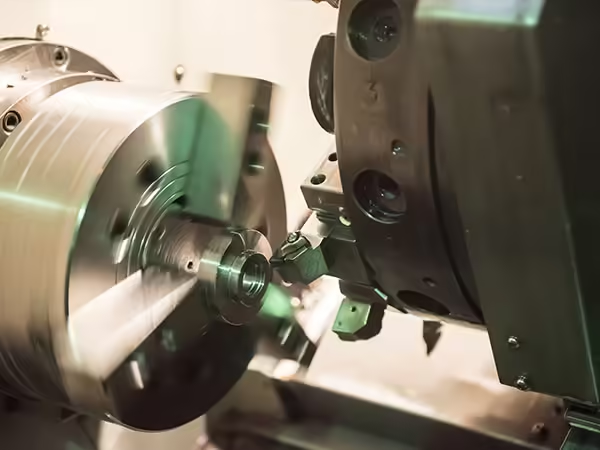
Investment Casting Technology
Investment casting, also called lost-wax casting, is one of the most important technologies used in precision impeller manufacturing.
How Investment Casting Works
The process typically includes:
- Wax pattern production
- Ceramic shell coating
- Wax removal
- Metal pouring
- Shell removal
- Tratamiento térmico
- Mecanizado de precisión
- Final inspection
Ventajas de la fundición de precisión
Superior Dimensional Accuracy
Investment casting can achieve tolerances as precise as:
- CT4–CT6 according to ISO 8062
- Blade profile accuracy within ±0.1 mm
Acabado de superficie lisa
Typical surface roughness:
- Ra3.2–Ra6.3 μm
This helps improve fluid flow efficiency.
Complex Geometries
Investment casting supports:
- Thin blades
- Curved flow paths
- Internal cavities
- Multi-channel structures
Industries Using Investment-Cast Impellers
- Petrochemical processing
- Pharmaceutical production
- Food-grade pumps
- Marine engineering
- Desalination systems
- Nuclear auxiliary systems
Sand Casting in China Impeller Casting
Although investment casting dominates precision impeller production, sand casting remains essential for large components.
Why Sand Casting Is Still Important
Sand casting offers:
- Lower tooling costs
- Shorter lead times
- Large-size capability
- Flexible production volumes
Typical Sand-Cast Components
- Carcasas de bombas
- Volute casings
- Large slurry pump bodies
- Structural pump frames
Green Sand vs Resin Sand
| Tipo | Características | Aplicaciones |
|---|---|---|
| Green Sand | Lower cost | Standard industrial parts |
| Resin Sand | Higher precision | Heavy-duty pump systems |
CNC Machining and Secondary Processing
Casting alone cannot achieve all functional tolerances required in modern pumps.
Key Machining Areas
Critical machined surfaces include:
- Shaft bores
- Seal faces
- Bearing seats
- Coupling interfaces
Precision Standards
Advanced CNC systems can achieve:
| Parameter | Typical Accuracy |
|---|---|
| Concentricity | ≤0.01 mm |
| Flatness | ≤0.02 mm |
| Position Tolerance | ±0.005 mm |
These tolerances are crucial for vibration control.
Material Selection in China Impeller Casting
Serie de acero inoxidable
316/316L Stainless Steel
One of the most common materials in precision impeller casting.
Main Advantages
- Excelente resistencia a la corrosión
- Chloride resistance
- Good weldability
- Stable high-temperature performance
Aplicaciones comunes
- Chemical pumps
- Acid transfer pumps
- Marine fluid systems
304/304L Stainless Steel
A versatile and economical stainless alloy.
Best Uses
- Food processing pumps
- Clean water systems
- General industrial applications
Acero inoxidable dúplex
2205 Duplex Steel
2205 duplex steel combines high strength with excellent corrosion resistance.
Beneficios clave
- High pitting resistance
- Excellent fatigue strength
- Strong seawater performance
Aplicaciones típicas
- Offshore pumps
- Plantas desalinizadoras
- Marine cooling systems
Carbon Steel Materials
Acero al carbono 1045
Widely used in non-corrosive environments.
características
- Good machinability
- Alta resistencia
- Cost-effective
4130 Alloy Steel
Suitable for high-pressure industrial systems.
Ventajas
- Heat resistance
- Structural strength
- Good toughness
Special Alloy Materials
C95400 Bronze
Frequently used in seawater environments.
Características
- Self-lubricating properties
- Excellent wear resistance
- Strong anti-corrosion capability
Cobalt-Based Alloys
Examples include Co6 wear-resistant alloys.
Aplicaciones
- High-temperature impellers
- Abrasive slurry pumps
- Severe wear environments
Fluid Dynamics and Impeller Design Optimization
Blade Geometry Design
Impeller blades directly determine pump performance curves.
Key Design Parameters
| Design Factor | Influence |
|---|---|
| Blade Angle | Pressure generation |
| Blade Thickness | Structural stability |
| Blade Curvature | Flow efficiency |
| Inlet Diameter | Suction performance |
| Outlet Width | Flow capacity |
CFD Simulation Technology
Modern China impeller casting manufacturers increasingly use Computational Fluid Dynamics (CFD) software.
CFD allows engineers to simulate:
- Flow turbulence
- Pressure distribution
- Cavitation zones
- Velocity patterns
This reduces design errors before production begins.
Cavitation Resistance in Pump Systems
What Is Cavitation?
Cavitation occurs when vapor bubbles form and collapse inside the pump.
This can cause:
- Surface pitting
- Noise
- Vibration
- Efficiency loss
How Precision Casting Helps
Smooth internal surfaces reduce flow disturbances and minimize cavitation risks.
Advanced blade design also improves pressure distribution.
Heat Treatment in China Impeller Casting
Heat treatment improves mechanical performance after casting.
Common Heat Treatment Methods
| Método | Objetivo |
|---|---|
| Recocido | Reduce internal stress |
| Quenching | Increase hardness |
| Tempering | Improve toughness |
| Solution Treatment | Enhance corrosion resistance |
Why Heat Treatment Matters
Proper heat treatment improves:
- Resistencia a la fatiga
- Dimensional stability
- Wear resistance
- Structural reliability
Quality Control Standards in China Impeller Casting
Normas internacionales
Professional manufacturers often follow:
- ISO 9001
- ASTM standards
- DIN standards
- API standards
- ASME specifications
Ensayos no destructivos (END)
Métodos comunes de inspección
Ultrasonic Testing (UT)
Detects internal defects.
Magnetic Particle Inspection (MPI)
Identifies surface cracks in ferromagnetic materials.
Dye Penetrant Testing (PT)
Suitable for stainless steel components.
X-Ray Radiographic Testing
Used for critical pressure-containing components.
Spectrometer Material Analysis
Chemical composition verification ensures alloy compliance.
Typical elements analyzed include:
- Chromium
- Níquel
- Molybdenum
- Carbono
- Manganeso
Dynamic Balancing Technology
Why Balancing Is Critical
Imbalance can cause:
- Shaft vibration
- Bearing failure
- Seal leakage
- Noise
Industrial Balancing Standards
Many manufacturers follow:
- ISO 1940 balancing grades
High-speed impellers often require G2.5 or better.
Common Defects in China Impeller Casting
Shrinkage Porosity
Caused by improper solidification.
Prevention Methods
- Optimized gating systems
- Directional solidification
- Simulation analysis
Gas Porosity
Occurs when trapped gas forms cavities.
Soluciones
- Vacuum casting
- Improved shell permeability
- Controlled pouring temperatures
Cracking Issues
Thermal stress may create cracks.
Prevención
- Enfriamiento controlado
- Heat treatment optimization
- Improved alloy selection
Surface Roughness Problems
Poor surface quality affects fluid efficiency.
Soluciones
- Better shell materials
- Precision finishing
- Improved mold coatings
Environmental Sustainability in China Impeller Casting
Green Manufacturing Trends
Many foundries are reducing environmental impact through:
- Sand recycling systems
- Energy-efficient furnaces
- Emission control equipment
- Water recycling systems
Low-Carbon Manufacturing
The casting industry is increasingly adopting:
- Electric induction furnaces
- Renewable energy integration
- Smart energy monitoring
Industry Case Study: Chemical Pump Impeller Upgrade
Project Background
A chemical processing plant experienced severe corrosion and cavitation issues in its centrifugal pumps.
Original Problems
- Frequent impeller replacement
- Excessive downtime
- Reduced flow efficiency
Solution
The manufacturer upgraded to:
- 316L precision investment-cast impellers
- Optimized blade geometry
- Improved dynamic balancing
Results
| Performance Metric | Improvement |
|---|---|
| Service Life | +40% |
| Eficiencia energética | +8% |
| Frecuencia de mantenimiento | -35% |
| Pump Stability | Significantly improved |
Industry News and Market Trends
Rising Demand for Energy-Efficient Pumps
According to industrial energy reports, pump systems account for approximately 20% of global industrial electricity consumption.
High-efficiency impeller design is becoming a key investment focus worldwide.
Smart Manufacturing Expansion
China’s precision casting industry continues adopting:
- AI-assisted defect detection
- Robotic grinding systems
- Digital twin technology
- Automated pouring control
These upgrades improve consistency and production efficiency.
How Buyers Choose a Reliable China Impeller Casting Supplier
Engineering Support Capabilities
Strong suppliers provide:
- DFM analysis
- CFD simulation
- Material recommendations
- Prototype development
Flexibilidad de producción
Reliable manufacturers support:
- Small-batch customization
- Mass production
- Creación rápida de prototipos
- OEM/ODM services
Inspection Transparency
Professional suppliers should provide:
- Material certificates
- Dimensional reports
- NDT reports
- Balancing certificates
Lead Time Management
Typical production cycles:
| Production Type | Average Lead Time |
|---|---|
| Prototype Samples | 2-4 săptămâni |
| Investment Casting Production | 4-8 săptămâni |
| Large Sand Castings | 6–10 weeks |
Future Technologies in China Impeller Casting
3D Printing Integration
3D printing improves:
- Prototype speed
- Mold accuracy
- Complex geometry development
Benefits for Pump Design
- Faster R&D cycles
- Reduced tooling costs
- Better customization flexibility
AI-Based Quality Inspection
Machine vision systems can automatically detect:
- Grietas superficiales
- Dimensional deviations
- Porosity defects
This improves inspection consistency.
Digital Twin Manufacturing
Digital twin systems simulate production conditions before actual casting begins.
Benefits include:
- Reduced scrap rates
- Better process optimization
- Faster troubleshooting
Conclusión
The global pump industry continues moving toward higher efficiency, lower energy consumption, and longer operational life. As one of the most critical pump components, the impeller plays a decisive role in determining hydraulic performance and equipment reliability.
moderno China impeller casting manufacturers now combine precision investment casting, advanced CNC machining, CFD simulation, automated inspection systems, and high-performance alloy development to produce world-class pump components for demanding industrial applications.
From chemical processing and marine engineering to mining and water treatment, precision impeller casting provides measurable improvements in efficiency, wear resistance, corrosion protection, and maintenance reduction.
As smart manufacturing technologies continue evolving, China impeller casting is expected to play an even greater role in the future of global industrial pump systems.
PREGUNTAS FRECUENTES
What is China impeller casting mainly used for?
China impeller casting is primarily used for centrifugal pumps, slurry pumps, chemical pumps, marine pumps, and industrial fluid handling systems.
Why is investment casting preferred for impellers?
Investment casting offers high dimensional accuracy, smooth surfaces, and the ability to create complex blade geometries.
Which material is best for seawater pumps?
2205 duplex stainless steel and bronze alloys are commonly used because of their excellent chloride corrosion resistance.
How precise can impeller casting be?
High-quality investment casting can achieve tolerances close to ±0.1 mm depending on design complexity.
How do manufacturers reduce cavitation problems?
Manufacturers improve blade geometry, smooth internal surfaces, and optimize flow paths through CFD analysis.
What testing methods are used in precision casting?
Common methods include ultrasonic testing, X-ray inspection, dye penetrant testing, hardness testing, and spectrometer analysis.
How does CNC machining improve pump performance?
CNC machining ensures accurate sealing surfaces, concentric shaft alignment, and balanced rotation.
Why is dynamic balancing important?
Proper balancing reduces vibration, improves bearing life, minimizes noise, and increases pump reliability.
Can China impeller casting meet international standards?
Yes. Many manufacturers comply with ISO, ASTM, API, DIN, and ASME standards.
Categorías de productos
- Piezas de válvulas
- Piezas de la bomba de agua
- Piezas de la caja de cojinetes
- Piezas de fundición a presión
- Productos para bombas de acero inoxidable
- Productos para bombas de hierro fundido
- Piezas de válvulas para automóviles
- Recambios para automóviles
- Piezas de válvulas para uso civil
- Piezas de bomba de vacío KF

¡Comencemos tu próximo proyecto!
Inicie su proyecto con Leierwo
1. Envíe su consulta
2. Cálculo de costes
3. Inicio de la producción
4. Organizar la entrega
PREGUNTAS FRECUENTES
Sí, tenemos una amplia experiencia en el comercio internacional y podemos ayudar a los clientes con el despacho de aduanas de exportación y los arreglos de envío. Aceptamos varios métodos de pago internacionales, incluyendo T/T (transferencia telegráfica), transferencia bancaria y carta de crédito (L/C). Las condiciones de pago se pueden discutir con nuestro equipo de ventas.
Al asociarse con Leierwo, podrá disfrutar de precios competitivos y una calidad superior a la de otros proveedores. Además, ofrecemos una solución integral para entregar piezas acabadas, incluido el mecanizado CNC y el tratamiento de superficies, lo que garantiza un proceso de producción sin fisuras.
Contamos con avanzados equipos de fundición y estrictos sistemas de control de calidad. Nuestra capacidad de producción mensual es considerable y podemos fabricar productos a partir de dibujos o muestras proporcionados por el cliente. Aceptamos tanto pequeños pedidos de prueba como producciones a gran escala.
Nuestros productos cumplen normas internacionales como ASTM, AISI, DIN y JIS. Podemos proporcionar informes de pruebas de materiales y certificaciones pertinentes para garantizar que la calidad del producto cumple los requisitos del cliente.
Seguimos estrictamente el sistema de gestión de calidad ISO 9001 y realizamos múltiples inspecciones a lo largo del proceso de producción, incluidos análisis espectrográficos, pruebas de rayos X, pruebas ultrasónicas y mediciones dimensionales. Estas medidas de control de calidad garantizan que nuestras piezas de fundición cumplen las normas más estrictas.
Sin embargo, somos flexibles y estamos abiertos a discutir sus necesidades específicas.
Nuestro plazo de producción estándar es de 4 a 6 semanas, en función de la cantidad del pedido y la complejidad del producto. Nos esforzamos por acortar los plazos de entrega para satisfacer las demandas de los clientes.
Sí, podemos proporcionar muestras para la inspección de calidad. Los costes de las muestras y los gastos de envío pueden negociarse, y los gastos de las muestras pueden reembolsarse al realizar un pedido formal.
 Spanish
  English
  Arabic
  Malay
Malay  German