
Custom Water Pump Casting Parts for Industry Use: A Complete Engineering Guide
Ich freue mich sehr, dass du hier bist! Bevor wir uns in die Inhalte vertiefen, würde ich mich freuen, wenn du mir auf meinen Social-Media-Plattformen folgst. Dort teile ich zusätzliche Einblicke, vernetze mich mit unserer großartigen Community und halte dich über die neuesten Nachrichten auf dem Laufenden. So bleibst du in Verbindung:
📘 Facebook: Shanghai Leierwo Industriehandel Co., Ltd.
Lassen Sie uns gemeinsam auf diese Reise gehen! Ich hoffe, Sie finden die Inhalte hier nicht nur aufschlussreich, sondern auch inspirierend und wertvoll. Los geht‘s!
Inhaltsverzeichnis
Wichtigste Erkenntnisse
- Water pump casting parts determine pump efficiency, durability, and long-term operating cost
- Advanced casting processes improve hydraulic performance and reduce cavitation risk
- Material standards such as ASTM and ISO play a key role in industrial pump selection
- Investment casting enables high-precision impeller geometry up to ±0.1 mm
- Proper alloy selection can extend pump lifespan by 30%–200% depending on application
- Industry case studies show up to 18% energy savings with optimized casting design
- Quality inspection and non-destructive testing are critical for reliability assurance
Einführung
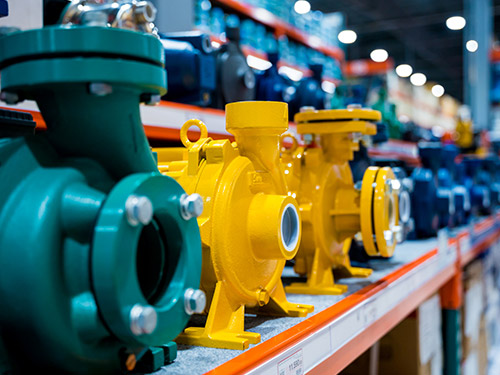
In modern industrial systems, pumps are not just mechanical devices—they are energy transfer systems that directly affect production efficiency, operational stability, and lifecycle cost.
At the center of every high-performance pump lies a critical foundation: water pump casting parts.
These components define:
- Hydraulic efficiency
- Structural durability
- Korrosionsbeständigkeit
- Maintenance cycles
- Energy consumption
According to multiple industrial fluid engineering studies (including data published by Hydraulic Institute and ISO 5199 guidelines), poor casting quality can reduce pump efficiency by 8% to 25%, abhängig von den Betriebsbedingungen.
This makes casting quality not just a manufacturing concern—but a system-level performance factor.
Global Industry Standards for Water Pump Casting Parts
Industrial pumps are governed by strict international standards to ensure safety, interchangeability, and performance consistency.
ISO 9906 – Pump Performance Testing Standard
Defines hydraulic performance testing requirements for rotodynamic pumps.
Key requirements include:
- Flow rate tolerance: ±3% to ±8% depending on grade
- Head measurement accuracy: ±1%–±5%
- Efficiency deviation limits strictly controlled
ASTM A743 / A744 – Stainless Steel Castings
Widely used for pump components exposed to corrosive fluids.
Key grades include:
- CF8 (304 equivalent)
- CF8M (316 equivalent)
ISO 5199 – Chemical Pump Design Standard
Defines:
- Minimum wall thickness
- Pressure containment requirements
- Mechanical sealing standards
These standards ensure that water pump casting parts meet global industrial interoperability requirements.
Engineering Role of Water Pump Casting Parts in System Performance
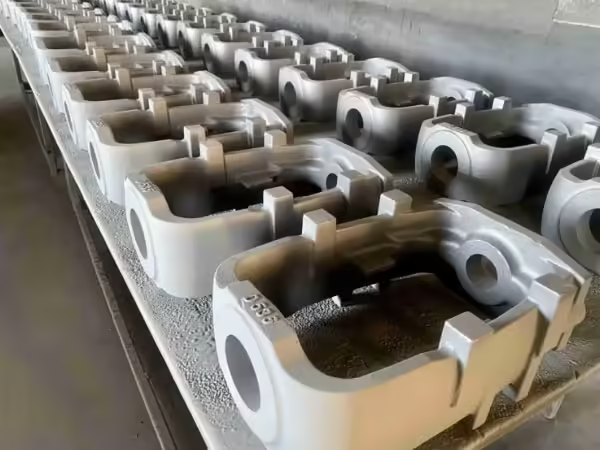
Hydraulic Efficiency Control
Water pump performance depends heavily on internal flow channel smoothness.
Even a Ra 12.5 μm roughness increase can reduce efficiency by 3–6% due to turbulence losses.
Structural Load Distribution
Pump housings must withstand:
- Internal pressure up to 2.5 MPa in industrial systems
- Thermal expansion in high-temperature operations
- Vibrational stress from rotating impellers
Kavitationsbeständigkeit
Cavitation occurs when vapor bubbles collapse under pressure.
This can erode impellers and reduce lifespan by up to 70% if not properly designed.
Water Pump Casting Parts Material Engineering Deep Dive
Stainless Steel Engineering Series
316L Stainless Steel (Most Widely Used Industrial Grade)
- Chromium: 16–18%
- Nickel: 10–14%
- Molybdenum: 2–3%
Key properties:
- Pitting resistance equivalent number (PREN): ~24–28
- Excellent chloride corrosion resistance
- Suitable for seawater and chemical pumping systems
Duplex 2205 Stainless Steel
- Yield strength: ~450 MPa (nearly double of 316L)
- PREN: >35
- Excellent resistance to stress corrosion cracking
Used in offshore pumping systems and desalination plants.
Carbon Steel Engineering Series
ASTM A216 WCB Equivalent (1045-based applications)
- Tensile strength: 485–655 MPa
- Cost-efficient for non-corrosive fluids
- Widely used in HVAC and irrigation systems
4130 Alloy Steel
- Hohe Ermüdungsfestigkeit
- Used in high-pressure pump shafts
- Temperature resistance up to 400°C in continuous operation
Specialty Alloy Systems
C95400 Aluminum Bronze
- Hardness: ~170–200 HB
- Excellent anti-galling performance
- Ideal for sliding wear surfaces
Cobalt-Based Alloy (Stellite 6 Equivalent)
- Hardness: up to 40–45 HRC
- Used in abrasive slurry pumps
- Excellent erosion resistance
Advanced Manufacturing Technology for Water Pump Casting Parts
Investment Casting Precision Technology
Investment casting is widely used for high-efficiency impellers.
Technical Capabilities:
- Dimensional accuracy: ±0.1 mm
- Surface finish: Ra 3.2 μm or better
- Wall thickness control: ±5% variation
Hydraulic Impact:
According to hydraulic engineering simulations:
- Flow efficiency improvement: 8%–15%
- Reduced turbulence zones: up to 30%
- Lower cavitation probability
Sand Casting for Heavy-Duty Pump Bodies
Sand casting remains the dominant method for large industrial pump housings.
Vorteile:
- Suitable for components >200 kg
- Flexible design adaptation
- Niedrige Werkzeugkosten
Einschränkungen:
- Rougher surface finish (Ra 12.5–25 μm)
- Requires secondary machining
CNC Precision Machining Integration
Modern pump manufacturing integrates CNC finishing for critical tolerances.
Precision Targets:
- Shaft alignment tolerance: ≤0.01 mm
- Sealing surface flatness: ≤0.005 mm
- Concentricity: ≤0.01 mm
This directly affects:
- Vibration reduction
- Seal lifetime
- Bearing stability
Water Pump Casting Parts Manufacturing Process Flow
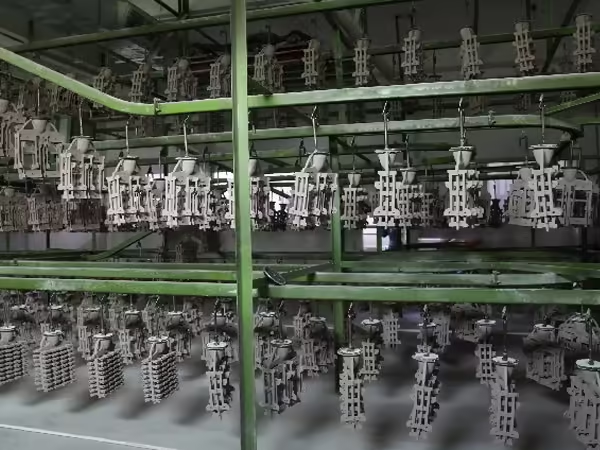
Step 1: Design Simulation (CFD Analysis)
Computational Fluid Dynamics (CFD) is used to:
- Optimize impeller geometry
- Reduce flow separation
- Improve efficiency curves
Step 2: Mold Design & Pattern Making
Precision mold design ensures repeatability.
Step 3: Melting & Alloy Control
Temperature control range:
- Stainless steel: 1450–1550°C
- Carbon steel: 1500–1600°C
Step 4: Casting & Solidification Control
Cooling rate affects:
- Grain size
- Strength distribution
- Innere Porosität
Step 5: Heat Treatment
Common processes:
- Glühen
- Normalisierung
- Quenching & tempering
Step 6: Machining & Finishing
Critical sealing and rotating interfaces are CNC machined.
Step 7: Quality Inspection
Includes:
- Röntgenuntersuchung
- Ultrasonic testing (UT)
- Magnetic particle testing (MT)
Gussteile für Wasserpumpen vs Fabricated Parts Comparison
| Besonderheit | Casting Parts | Fabricated/Welded Parts |
|---|---|---|
| Structural Integrity | Hoch | Medium |
| Kosteneffizienz | High for mass production | Low for mass production |
| Designflexibilität | High complexity possible | Beschränkt |
| Leak Risk | Niedrig | Higher due to welds |
| Hydraulic Performance | Optimized flow paths | Less optimized |
Industry Case Study: Chemical Plant Pump Efficiency Upgrade
Project Background
A chemical processing plant in Southeast Asia upgraded 24 centrifugal pumps.
Problem
- Frequent impeller wear
- Efficiency loss after 6–8 months
- High maintenance downtime
Lösung
Upgraded to:
- 316L stainless steel investment-cast impellers
- Duplex steel pump housings
- CNC precision sealing interfaces
Results
- Efficiency improvement: +12.7%
- Maintenance interval extended: 2.3× longer
- Annual energy savings: ~14%
Failure Analysis of Water Pump Casting Parts
1. Cavitation Damage
Occurs when vapor bubbles collapse violently.
Symptoms:
- Pitted impeller surfaces
- Reduced flow efficiency
2. Corrosion Failure
Caused by chloride ions or acidic fluids.
Common in seawater applications.
3. Erosion Wear
Occurs in slurry and mining applications.
Solution: cobalt alloy reinforcement.
4. Casting Porosity
Internal voids reduce mechanical strength.
Detected using:
- Röntgenuntersuchung
- Ultraschallprüfung
Water Pump Casting Parts Inspection Standards
Dimensionsinspektion
- CMM (Coordinate Measuring Machine) used
- Tolerance range: ±0.02 mm standard industrial requirement
Druckprüfung
- Hydrostatic test pressure: 1.5×–2× working pressure
Surface Roughness Testing
- Ra values measured for hydraulic efficiency control
Digital Manufacturing Trends in Water Pump Casting Industry
Smart Foundry Systems
Modern foundries use IoT sensors to monitor:
- Furnace temperature
- Cooling rate
- Mold conditions
AI-Based Defect Prediction
Machine learning models detect:
- Porosity risk
- Shrinkage defects
- Cracking probability
3D-gedrucktes Gussteil Molds
Reduces lead time by 30–60% in prototype production.
Market Insight: Global Pump Casting Industry Outlook
According to industrial market reports:
- Global pump market size exceeds USD 70+ billion
- Casting components account for 35%–50% of total pump cost
- Demand growth is driven by water infrastructure and energy industries
- Asia-Pacific region leads production due to manufacturing density
Abschluss
The performance of industrial pumping systems depends heavily on the engineering quality of water pump casting parts. From material science to precision casting processes and CNC finishing, every stage influences efficiency, reliability, and lifecycle cost.
With increasing industrial demand for energy efficiency and sustainability, advanced casting technologies are becoming a core competitive advantage in global pump manufacturing.
Choosing the right materials, processes, and suppliers is not just a procurement decision—it is a long-term engineering investment in system performance and operational stability.
Häufig gestellte Fragen
Was sind water pump casting parts used for in industry?
They are used to form structural and hydraulic components such as pump bodies, impellers, and housings that enable fluid transfer.
Which material is best for corrosive environments?
316L stainless steel and duplex stainless steel are most commonly used due to strong chloride resistance.
Why is investment casting important for pump impellers?
It ensures high dimensional accuracy and smooth surfaces, improving hydraulic efficiency and reducing energy loss.
How long do industrial pump casting parts last?
Depending on material and environment, lifespan ranges from 3 to 15+ years.
What causes most pump casting failures?
Cavitation, corrosion, improper material selection, and casting defects such as porosity.
Produktkategorien
- Ventilteile
- Wasserpumpenteile
- Lagergehäuseteile
- Druckgussteile
- Pumpenprodukte aus Edelstahl
- Pumpenprodukte aus Gusseisen
- Ventilteile für den Automobilgebrauch
- Autoteile
- Ventilteile für den zivilen Gebrauch
- Vakuumpumpenteile KF

Lassen Sie uns Ihr nächstes Projekt starten!
Starten Sie Ihr Projekt mit Leierwo
1. Senden Sie Ihre Anfrage
2. Kostenkalkulation
3. Produktion starten
4. Lieferung vereinbaren
Häufig gestellte Fragen
Ja, wir verfügen über umfassende Erfahrung im internationalen Handel und unterstützen unsere Kunden gerne bei der Exportzollabfertigung und Versandabwicklung. Wir bieten verschiedene Handelsbedingungen wie FOB, CIF und DDP an, um unterschiedlichen Logistikanforderungen gerecht zu werden. Wir akzeptieren verschiedene internationale Zahlungsmethoden, darunter T/T (Telegraphic Transfer), elektronische Überweisung und Akkreditiv (L/C). Die Zahlungsbedingungen können Sie mit unserem Vertriebsteam besprechen.
Durch die Partnerschaft mit Leierwo profitieren Sie von wettbewerbsfähigen Preisen und überlegener Qualität im Vergleich zu anderen Anbietern. Darüber hinaus bieten wir eine Komplettlösung für die Lieferung fertiger Teile, einschließlich CNC-Bearbeitung und Oberflächenbehandlung, und gewährleisten so einen reibungslosen Produktionsprozess.
Wir verfügen über moderne Gussanlagen und strenge Qualitätskontrollsysteme. Unsere monatliche Produktionskapazität ist beträchtlich und wir können Produkte nach Kundenzeichnungen oder Mustern fertigen. Wir akzeptieren sowohl kleine Probeaufträge als auch Großserienproduktionen.
Unsere Produkte entsprechen internationalen Normen wie ASTM, AISI, DIN und JIS. Wir stellen Materialprüfberichte und entsprechende Zertifizierungen bereit, um sicherzustellen, dass die Produktqualität den Kundenanforderungen entspricht.
Wir befolgen strikt das Qualitätsmanagementsystem ISO 9001 und führen während des gesamten Produktionsprozesses zahlreiche Prüfungen durch, darunter spektrografische Analysen, Röntgenprüfungen, Ultraschallprüfungen und Maßmessungen. Diese Qualitätskontrollmaßnahmen garantieren, dass unsere Gussteile den höchsten Standards entsprechen.
Unsere Mindestbestellmenge hängt von der Art und Komplexität des Produkts ab. Wir sind jedoch flexibel und offen für die Besprechung Ihrer spezifischen Anforderungen.
Unsere Standardproduktionszeit beträgt 4–6 Wochen, abhängig von Bestellmenge und Produktkomplexität. Wir sind bestrebt, die Lieferzeiten zu verkürzen, um den Kundenanforderungen gerecht zu werden.
Ja, wir können Muster zur Qualitätsprüfung bereitstellen. Musterkosten und Versandkosten können ausgehandelt werden. Die Mustergebühren können bei einer formellen Bestellung erstattet werden.
 German
  English
  Spanish
  Arabic
  Malay
Malay