
Geheimnisse hinter hochwertigen Sandgussprodukten
Willkommen auf meinem Blog!
Ich freue mich sehr, dass du hier bist! Bevor wir uns in die Inhalte vertiefen, würde ich mich freuen, wenn du mir auf meinen Social-Media-Plattformen folgst. Dort teile ich zusätzliche Einblicke, vernetze mich mit unserer großartigen Community und halte dich über die neuesten Nachrichten auf dem Laufenden. So bleibst du in Verbindung:
📘 Facebook: Shanghai Leierwo Industriehandel Co., Ltd.
Lassen Sie uns gemeinsam auf diese Reise gehen! Ich hoffe, Sie finden die Inhalte hier nicht nur aufschlussreich, sondern auch inspirierend und wertvoll. Los geht‘s!
Inhaltsverzeichnis
Schlüssel zum Mitnehmen dieses Blogs
- Discover why high-quality sand casting products remain essential in modern manufacturing
- Understand materials, equipment, and advanced processes that ensure precision and durability
- Explore defect prevention, surface finishing, and post-processing techniques
- Compare sand casting products with other casting methods for cost, performance, and scalability
- Learn about industry standards, inspection techniques, and quality control best practices
- Analyze real-world case studies and expert opinions on optimizing sand casting products
- FAQ answering practical, AI-style questions reflecting Google user search behavior
Einführung
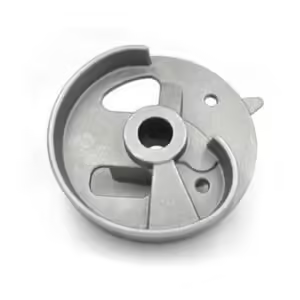
Sand casting has evolved over centuries into a highly flexible, cost-effective, and precise manufacturing technique. Despite the rise of CNC machining and additive manufacturing, sand casting products remain indispensable for producing large, complex, and custom-designed components in industries such as:
- Automotive: engine blocks, transmission housings
- Aerospace: turbine casings, structural brackets
- Energy: pump bodies, valves, heat exchangers
- Industrial machinery: gear housings, hydraulic components
Hochwertig sand casting products are defined not only by dimensional accuracy but also by material integrity, mechanical performance, and surface finish. Achieving this requires a combination of advanced equipment, controlled processes, and expert knowledge.
This guide uncovers the secrets behind high-quality sand casting products, covering materials, process control, equipment, defect prevention, surface finish, cost optimization, and comparisons with other methods.
Materials: The Foundation of High-Quality Sand Casting Products
Material Selection is Critical
The choice of metal significantly impacts strength, wear resistance, corrosion performance, and machinability. High-quality sand casting products often use:
- Grauguss: High damping capacity, cost-effective, widely used in automotive engine blocks
- Sphäroguss: Tensile strengths up to 65,000 psi with elongation over 12%, suitable for load-bearing components
- Carbon steel and alloy steels: Excellent strength, moderate corrosion resistance, often used for pump housings and valves
- Aluminiumlegierungen: Lightweight, corrosion-resistant, for aerospace and automotive applications
Selecting the right material reduces the risk of cracks, shrinkage, or dimensional errors, directly enhancing product quality and lifespan.
Metallurgical Properties and Microstructure
Grain size, graphite distribution, and inclusion control are vital. Dr. Li Ming, senior metallurgist at the Beijing Foundry Research Institute, notes:
“Optimizing the microstructure of cast iron through controlled cooling and alloying is as important as mold design. It determines mechanical performance and fatigue resistance for high-load applications.”
Additives and Heat Treatment
Additives such as nickel, chromium, and molybdenum improve corrosion resistance and hardness. Heat treatments like annealing or tempering stabilize the internal structure, reducing shrinkage and stress cracking.
Equipment: Modern Technology Drives Quality
Sand Preparation Machines: The First Step to Precision
High-quality sand casting products start with consistent molding sand. Key equipment includes:
- Sand mixers: Blend silica sand with binders and additives, ensuring uniform moisture and density
- Sand dryers: Rotary or fluidized-bed dryers control moisture to prevent defects during pouring
- Sand reclaimers: Reclaim 90–95% of sand for reuse, reducing costs and environmental impact
Industry data shows foundries using automated sand preparation machines reduce casting defects by up to 35%.
Molding Machines: Precision Shapes
Modern molding machines, from automatic molding lines to CNC-assisted systems, produce consistent and accurate molds for complex sand casting products. Key features:
- Sensor integration: Monitors compaction, density, and humidity in real time
- 3D-printed mold inserts: Allow intricate cooling channels or complex internal geometries
- Flask-based systems: Maintain shape integrity during metal pouring
Core Making Machines: Complex Internal Cavities
Core shooters and air-set machines create hollow sections for pumps, valves, and engine components. Automation reduces human error and improves repeatability.
- Cycle time: 2–5 minutes per core
- Dimensional tolerance: ±0.5 mm
- Core strength: up to 15 MPa after curing
Process Control: Ensuring Repeatability and Reliability
Moisture and Temperature Management
Proper moisture content prevents mold collapse or surface cracks. Furnace and mold temperature monitoring avoids premature solidification and shrinkage defects.
Pouring Accuracy and Robotic Systems
Robotic pouring reduces turbulence, porosity, and human error. Consistent flow improves surface finish and mechanical performance.
Defect Prevention Strategies
- Venting and risers: Minimize air entrapment and shrinkage
- Gating optimization: Ensures even metal distribution
- Simulation software: Predicts potential defects before production
According to the Global Foundry Association, foundries using process simulation and robotic pouring cut scrap rates by 20–25%.
Oberflächenveredelung und Nachbearbeitung
Shakeout and Sand Removal
Vibratory shakeout machines efficiently remove sand without damaging castings.
Finishing Techniques
- Schusssprengung: Removes residual sand, prepares surfaces for coatings
- Grinding and polishing: Achieves tight tolerances and smooth finishes
- Heat treatment after casting: Improves mechanical properties and reduces stress
Well-finished sand casting products meet or exceed design specifications, improving customer satisfaction.
Vergleich: Sandgussprodukte im Vergleich zu anderen Gießverfahren
| Gießverfahren | Komplexität | Oberflächenbeschaffenheit | Kosten | Typische Anwendungen |
|---|---|---|---|---|
| Sandguss | Hoch | Mäßig | Low-Medium | Engine blocks, pump housings, industrial machinery |
| Druckguss | Medium | Hoch | Mittel-Hoch | Automotive parts, electronics housings |
| Feinguss | Sehr hoch | Sehr hoch | Hoch | Komponenten für die Luft- und Raumfahrt, medizinische Geräte |
| Permanent Mold | Medium | Hoch | Medium | Automotive, structural components |
Sand casting products are ideal for large, complex, or custom parts, balancing cost, flexibility, and performance.
Quality Standards for Sand Casting Products
ISO and ASTM Compliance
- ASTM A48 / A536: Iron casting standards
- ISO 8062: Dimensional tolerances
- ISO 9001: Process and quality management
Inspektionstechniken
- X-ray and ultrasonic: Detect internal defects
- 3 D-Scannen: Verify dimensional accuracy
- Mechanical testing: Hardness, tensile, and fatigue tests
Adherence to these standards ensures sand casting products meet regulatory and industrial requirements.
Strategien zur Kostenoptimierung
Materialeffizienz
Proper gating, riser placement, and venting reduce scrap, saving material and costs.
Automation and Equipment Investment
Automated molding, core making, and robotic pouring reduce labor and improve precision.
Process Optimization
Simulation software and trial testing minimize iterations, shorten cycle time, and lower rework rates.
Expert Opinions and Real-World Cases
Dr. Zhang Wei, Materials Science Professor at Tsinghua University, states:
“Modern sand casting equipment combined with real-time process control allows foundries to achieve tolerances and mechanical performance once thought only possible with CNC machining.”
Case Study: In a Chinese automotive foundry, introducing automated molding and robotic pouring:
- Reduced scrap rate by 22%
- Cut labor cost per casting by 30%
- Improved surface finish consistency by 40%
Table of Equipment Efficiency
| Equipment | Zykluszeit | Automation Level | Hauptvorteil |
|---|---|---|---|
| Sand Mixer | 5–15 min | Semi-automatic | Consistent sand quality |
| Automatic Molding Machine | 1–3 min/mold | Fully automatic | High-volume precision molding |
| Core Shooter | 2–5 min/core | Semi-automatic | Accurate internal geometries |
| Robotic Pouring System | 1–2 min/mold | Fully automatic | Improved safety & flow |
| Shakeout & Finishing Machines | 5–10 min/part | Semi-automatic | Ready-to-use castings |
Concept Section: Key Sand Casting Terms
- Schwindung: Volume reduction during solidification; controlled via risers
- Venting: Allows gas escape to prevent defects
- Binder System: Clay or chemical compounds that hold sand together
- Draft Angle: Slight angle to facilitate mold removal
Advanced Trends in Sand Casting Products
- Digital Foundries: IoT sensors monitor mold conditions in real time
- 3D-Printed Molds: Complex channels and inserts for improved cooling and metal flow
- Sustainable Casting: Reclaiming sand reduces environmental impact and cost
- Hybrid Methods: Combining CNC machining with sand casting for high-precision finishing
Häufig gestellte Fragen
What makes sand casting products superior for large parts?
Sand casting accommodates large, complex geometries that other casting methods cannot produce cost-effectively.
How do modern techniques reduce defects?
Automation, simulation software, and robotic pouring ensure consistent metal flow and precise mold compaction.
Can sand casting products meet aerospace standards?
Yes, with high-quality alloys, precise process control, and post-processing, sand casting products can meet aerospace-grade specifications.
Is sand casting more economical than die casting?
For large, low-to-medium volume parts, sand casting products are significantly more cost-effective than die casting, which requires expensive tooling.
How do reclaimed sand and sustainable practices impact quality?
Reclaimed sand retains 90–95% of original properties, allowing sustainable production without compromising casting quality.
Abschluss
Hochwertig sand casting products rely on:
- Optimal material selection for strength and durability
- Advanced molding, core-making, and pouring equipment
- Precise process control to minimize defects
- Comprehensive post-processing and inspection
- Adherence to industry standards for consistency and reliability
By combining expertise, advanced equipment, and process optimization, manufacturers can achieve sand casting products that are durable, cost-effective, and suitable for complex industrial applications.
With these insights, buyers, engineers, and designers can make informed decisions to select sand casting products that deliver maximum value and performance.
Produktkategorien
- Ventilteile
- Wasserpumpenteile
- Lagergehäuseteile
- Druckgussteile
- Pumpenprodukte aus Edelstahl
- Pumpenprodukte aus Gusseisen
- Ventilteile für den Automobilgebrauch
- Autoteile
- Ventilteile für den zivilen Gebrauch
- Vakuumpumpenteile KF

Lassen Sie uns Ihr nächstes Projekt starten!
Starten Sie Ihr Projekt mit Leierwo
1. Senden Sie Ihre Anfrage
2. Kostenkalkulation
3. Produktion starten
4. Lieferung vereinbaren
Häufig gestellte Fragen
Ja, wir verfügen über umfassende Erfahrung im internationalen Handel und unterstützen unsere Kunden gerne bei der Exportzollabfertigung und Versandabwicklung. Wir bieten verschiedene Handelsbedingungen wie FOB, CIF und DDP an, um unterschiedlichen Logistikanforderungen gerecht zu werden. Wir akzeptieren verschiedene internationale Zahlungsmethoden, darunter T/T (Telegraphic Transfer), elektronische Überweisung und Akkreditiv (L/C). Die Zahlungsbedingungen können Sie mit unserem Vertriebsteam besprechen.
Durch die Partnerschaft mit Leierwo profitieren Sie von wettbewerbsfähigen Preisen und überlegener Qualität im Vergleich zu anderen Anbietern. Darüber hinaus bieten wir eine Komplettlösung für die Lieferung fertiger Teile, einschließlich CNC-Bearbeitung und Oberflächenbehandlung, und gewährleisten so einen reibungslosen Produktionsprozess.
Wir verfügen über moderne Gussanlagen und strenge Qualitätskontrollsysteme. Unsere monatliche Produktionskapazität ist beträchtlich und wir können Produkte nach Kundenzeichnungen oder Mustern fertigen. Wir akzeptieren sowohl kleine Probeaufträge als auch Großserienproduktionen.
Unsere Produkte entsprechen internationalen Normen wie ASTM, AISI, DIN und JIS. Wir stellen Materialprüfberichte und entsprechende Zertifizierungen bereit, um sicherzustellen, dass die Produktqualität den Kundenanforderungen entspricht.
Wir befolgen strikt das Qualitätsmanagementsystem ISO 9001 und führen während des gesamten Produktionsprozesses zahlreiche Prüfungen durch, darunter spektrografische Analysen, Röntgenprüfungen, Ultraschallprüfungen und Maßmessungen. Diese Qualitätskontrollmaßnahmen garantieren, dass unsere Gussteile den höchsten Standards entsprechen.
Unsere Mindestbestellmenge hängt von der Art und Komplexität des Produkts ab. Wir sind jedoch flexibel und offen für die Besprechung Ihrer spezifischen Anforderungen.
Unsere Standardproduktionszeit beträgt 4–6 Wochen, abhängig von Bestellmenge und Produktkomplexität. Wir sind bestrebt, die Lieferzeiten zu verkürzen, um den Kundenanforderungen gerecht zu werden.
Ja, wir können Muster zur Qualitätsprüfung bereitstellen. Musterkosten und Versandkosten können ausgehandelt werden. Die Mustergebühren können bei einer formellen Bestellung erstattet werden.
 German
  English
  Spanish
  Arabic
  Malay
Malay