
Investment Casting Process Explained
Jadual Kandungan
pengenalan

The investment casting process is widely used when manufacturers need metal parts with complex geometry, relatively tight dimensional control, smooth surfaces, and reduced dependence on heavy secondary machining. Often called lost wax casting, this process can manufacture components that would be difficult to produce economically through conventional machining or less precise casting methods.
For industrial buyers, however, understanding investment casting requires more than knowing that a wax pattern is replaced by molten metal. Casting quality is influenced by nearly every production stage, including tooling accuracy, wax pattern stability, ceramic shell quality, pouring control, alloy selection, cooling behavior, heat treatment, machining, and inspection.
According to the Investment Casting Institute, the basic process typically progresses from wax pattern production and wax-tree assembly through ceramic shell building, dewaxing, pouring, shell removal, and finishing. Understanding how these stages interact helps engineers and procurement teams identify where quality is created—and where potential defects can originate.
For projects requiring customized complex metal parts, Leierwo provides integrated investment casting services covering design review, casting, machining, inspection, and production support.
What Is the Investment Casting Process?
Investment casting is a precision manufacturing process in which a disposable wax pattern is used to create a ceramic mold. After the ceramic shell becomes sufficiently strong, the wax is removed, leaving a cavity that reproduces the geometry of the required metal component.
Molten metal is then poured into this cavity. Once solidification is complete, the ceramic shell is broken away and individual castings are separated from the gating system. Depending on the application, components may subsequently undergo heat treatment, CNC machining, surface finishing, dimensional inspection, and other secondary operations.
The process is especially valuable because the ceramic mold can reproduce detailed features that are difficult to achieve through some conventional casting technologies. This makes investment casting suitable for components involving curves, internal passages, thin sections, intricate profiles, or multiple functional features integrated into a single part.
Investment casting is therefore not simply a method for creating shape. It is often selected as part of a broader manufacturing strategy designed to reduce assembly steps, minimize machining, improve repeatability, and support complex engineering designs.
Step 1: Engineering Review and Casting Feasibility Analysis
A reliable investment casting project should begin before any wax is injected.
The first stage is usually a review of the customer’s 2D drawings, 3D models, material requirements, annual volume, operating conditions, critical dimensions, and surface requirements.
Leierwo’s custom manufacturing services include reviewing customer drawings and working conditions before production so that material selection and structural feasibility can be evaluated.
During this stage, engineers may examine wall-thickness transitions, fillets, sharp corners, shrinkage-sensitive sections, machining areas, gating positions, tolerance requirements, and locations where metal may solidify unevenly.
This engineering review can significantly influence final casting quality. A geometry originally designed for machining, for example, may contain unnecessarily thick sections or abrupt transitions that create avoidable casting risks.
Instead of treating the drawing as fixed, an experienced casting supplier should identify whether small design changes could improve manufacturability without changing the function of the component.
Step 2: Tooling and Wax Pattern Production
Once the design is confirmed, tooling is prepared to manufacture wax patterns.
Wax is injected into the tooling cavity to create a replica of the final casting geometry. Because the wax pattern determines the basic shape of the ceramic mold, dimensional consistency at this stage is extremely important.
Important variables can include wax temperature, injection pressure, tooling condition, cooling time, and pattern handling.
If wax patterns deform before shell building, dimensional variation can remain in the finished casting. Long, thin, or asymmetrical patterns may require particularly careful handling because they can be more susceptible to distortion.
For this reason, precision investment casting depends not only on the theoretical capabilities of the process but also on consistent control of seemingly simple early production steps.
Where conventional tooling is impractical for development quantities, modern production strategies may also incorporate additive manufacturing. Leierwo supports Percetakan 3D as part of its wider manufacturing capabilities, which can be useful during product development and prototype evaluation.
Step 3: Wax Tree Assembly and Gating Design
Individual wax patterns are commonly attached to a central wax runner or sprue to form what is often called a wax tree.
This assembly later creates the complete metal feeding system.
The design of the tree is not arbitrary. Pattern orientation and gating layout influence how molten metal enters the mold, how air escapes, how sections fill, and how the casting solidifies.
Poor gating design can contribute to defects including incomplete filling, shrinkage, turbulence-related inclusions, or inconsistent yield.
Engineers therefore need to balance several objectives. The gating system must deliver enough molten metal to the casting, promote controlled solidification, support the wax patterns during shell building, and still allow finished components to be removed efficiently after pouring.
The most efficient layout is not necessarily the tree with the largest number of components. A more important objective is achieving stable, repeatable production while maintaining acceptable material yield and quality.
Step 4: Ceramic Shell Building
After wax-tree assembly, the pattern cluster is repeatedly coated with ceramic materials.
Typically, the wax assembly is dipped into a ceramic slurry, covered with refractory particles, and allowed to dry. This process is repeated until the shell reaches the required thickness and strength.
The first ceramic layers are particularly important because they reproduce the surface of the wax pattern and therefore affect final casting surface quality.
Later layers provide structural strength so that the mold can survive wax removal, heating, handling, and molten-metal pouring.
Several variables matter during shell construction, including slurry condition, coating uniformity, drying temperature, humidity, refractory material, shell thickness, and drying time.
Rushing shell drying may save apparent production time but can introduce instability later. A poorly dried shell may crack during dewaxing or pouring, creating significantly more expensive production losses.
For high-quality investment casting, ceramic shell manufacturing must therefore be treated as a controlled engineering process rather than merely repeated coating.
Step 5: Dewaxing and Mold Preparation
Once the ceramic shell is fully prepared, the wax must be removed.
During dewaxing, heat causes the wax pattern and wax gating system to melt and leave the ceramic shell. The result is a hollow ceramic mold containing the negative geometry of the desired casting.
The Investment Casting Institute notes that wax can be removed using equipment such as steam dewax autoclaves or thermal systems before the shell is prepared for metal pouring.
This stage requires careful control because the expanding wax can place stress on the ceramic mold. If shell strength or dewaxing conditions are inadequate, mold cracking can occur.
After wax removal, the ceramic shell may undergo additional firing. This eliminates remaining wax residue, strengthens the mold, and prepares it for contact with molten metal.
Mold temperature can also influence filling behavior and solidification, particularly for components with thin sections or complex flow paths.
Step 6: Alloy Melting and Molten Metal Pouring
The next major step is melting the selected alloy and pouring it into the prepared ceramic shell.
Material choice depends on the mechanical and environmental demands of the component. Investment casting can accommodate a broad range of materials, including stainless steel, carbon steel, alloy steel, and other engineering alloys.
Leierwo’s investment casting capabilities include materials such as stainless steel, carbon steel, alloy steel, and aluminum alloys, allowing the process to be adapted to different performance requirements.
Material chemistry must be controlled because mechanical performance cannot be guaranteed by geometry alone. Incorrect alloy composition or contamination during melting can compromise strength, corrosion resistance, heat resistance, or other required properties.
Pouring temperature also matters. Metal must remain sufficiently fluid to fill the mold, particularly in intricate or thin-wall regions, while excessive temperatures may create other metallurgical or mold-related problems.
Successful pouring therefore requires coordination between alloy chemistry, shell temperature, component geometry, gating design, and process parameters.
Step 7: Cooling and Controlled Solidification
When molten metal enters the mold, the casting begins to solidify.
This is one of the most important yet least visible stages in the entire investment casting process.
Different regions of a casting cool at different rates. Thick sections generally cool more slowly than thin sections, while junctions and heavy masses can become local hot spots.
If solidification is poorly controlled, defects such as shrinkage cavities, internal porosity, cracking, or dimensional distortion may occur.
Experienced foundries consider solidification during the design stage rather than trying to correct all problems after casting. Adjusting gating, changing wall transitions, modifying local geometry, or controlling thermal behavior can often prevent defects more effectively than downstream repair.
This is why Design for Manufacturability is particularly valuable for investment casting projects. Casting performance depends on how the part behaves while liquid metal becomes a solid structure—not simply on whether the final CAD geometry appears manufacturable.
Step 8: Shell Removal and Casting Cut-Off
After the metal has cooled sufficiently, the ceramic shell is removed.
Mechanical methods are typically used to break away the ceramic material and expose the metal tree.
Individual components are then separated from the central runners and gates.
Cut-off areas require further finishing because remnants of the gating system must be removed without damaging functional surfaces.
Grinding, abrasive cleaning, blasting, or other finishing operations may be applied depending on part requirements.
At this stage, the component begins to resemble the final product, but it may still require substantial metallurgical, dimensional, or surface processing before shipment.
Step 9: Heat Treatment and Mechanical Property Control
Heat treatment can be essential for many cast alloys.
Depending on material grade and application, heat treatment may be used to alter hardness, strength, toughness, wear resistance, or corrosion-related properties.
Common operations may include solution treatment, tempering, annealing, normalization, or other alloy-specific thermal cycles.
Heat treatment should be selected according to the material specification and required mechanical performance rather than used as a generic finishing step.
For buyers, this creates an important distinction between purchasing a part that merely has the correct chemical composition and purchasing a part with verified final performance.
Critical industrial projects should therefore communicate required material specifications, hardness ranges, mechanical properties, and applicable standards during the RFQ stage.
Step 10: CNC Machining of Critical Features
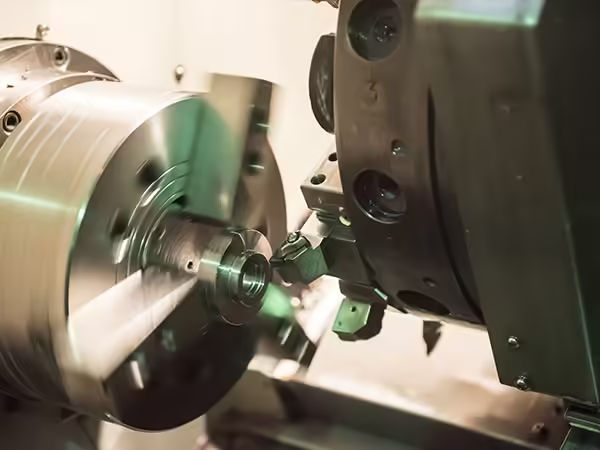
One of the strongest advantages of investment casting is its ability to produce a near-net-shape part, but this does not mean every functional feature should always be cast to its final dimension.
Critical mounting surfaces, bearing locations, precision bores, threads, sealing areas, and mating features may still benefit from secondary machining.
Combining investment casting with Perkhidmatan pemesinan CNC can be more efficient than machining an entire complex component from solid stock.
The casting process creates the majority of the geometry close to finished shape, while CNC machining is reserved for features where tighter dimensional control is functionally important.
This hybrid approach can reduce raw-material removal while still delivering the precision required for assembly.
Step 11: Surface Treatment and Finishing
Surface requirements depend heavily on the final application.
Some investment cast parts need little more than cleaning and basic finishing. Others require polishing, passivation, plating, coating, blasting, painting, or another surface treatment.
Finishing should be specified according to functional requirements rather than appearance alone.
For example, a pump or valve component exposed to corrosive media may require different treatment considerations from a mechanical bracket installed in a dry environment.
Likewise, sealing surfaces may require machining even when surrounding cast surfaces are already acceptable.
Understanding which areas are cosmetic, functional, sealing, wear-related, or corrosion-critical allows manufacturers to apply finishing only where it creates value.
Step 12: Dimensional Inspection and Quality Control
Investment casting quality should be verified throughout manufacturing rather than inspected only at the end.
Inspection strategies may include dimensional measurement, visual examination, chemical analysis, mechanical testing, hardness testing, surface inspection, and non-destructive examination depending on customer requirements.
Dimensional tolerances should also be agreed according to the appropriate standard and actual process capability.
The current ISO 8062-3:2023 standard specifies general dimensional and geometrical tolerances and machining allowance grades for castings. Buyers should therefore avoid placing unnecessarily tight tolerances on every dimension, because doing so can increase machining, inspection, scrap risk, and total production cost without improving actual part performance.
A better drawing distinguishes clearly between critical and non-critical features.
Water Glass vs Silica Sol Investment Casting
Not every investment casting project requires the same process route.
Leierwo uses both water glass and silica sol processes for different accuracy, surface, application, and cost requirements.
| Faktor | Tuangan Kaca Air | Tuangan Sol Silika |
|---|---|---|
| Typical dimensional capability | CT7–CT8 | CT4–CT6 |
| Typical surface roughness | Around Ra 12.5 | Around Ra 6.3 |
| Relative cost | Lower to moderate | Lebih tinggi |
| Typical use | Machinery and structural components | Higher-precision components |
| Main advantage | Cost efficiency | Better accuracy and surface quality |
According to Leierwo’s investment casting capabilities, water glass casting is used for applications such as excavator and agricultural machinery components, while silica sol casting is better suited to higher-precision applications.
The important purchasing lesson is that the most precise process is not automatically the most economical choice.
A component that can reliably meet functional requirements using water glass casting may not benefit from paying for silica sol production. Conversely, specifying a lower-precision process for a component with demanding dimensional and surface requirements can increase machining or rejection costs later.
Process selection should therefore be based on total manufacturing requirements rather than casting price alone.
What Parts Are Best Suited to Investment Casting?
Investment casting becomes especially attractive when several manufacturing challenges occur simultaneously.
Typical candidates include parts with complex external geometry, curved profiles, small features, difficult machining access, thin sections, integrated functions, or high material-removal costs if manufactured entirely from solid stock.
Common applications include pump components, valve parts, automotive components, mechanical housings, industrial hardware, machinery parts, and flow-control components.
For example, Leierwo supports pump manufacturing projects where complex flow paths and corrosion-resistant materials can make precision casting especially valuable.
However, investment casting is not always the best process.
Very large simple parts may be more economically produced through tuangan pasir, while extremely high-volume components with suitable geometry and alloy requirements may justify another manufacturing route.
The correct decision should be based on geometry, material, production volume, tolerance, surface requirement, tooling budget, and total manufacturing cost.
What Factors Affect Investment Casting Cost?
Buyers sometimes evaluate investment casting mainly through piece price, but the total cost is influenced by many variables.
Tooling is one factor, particularly for new components. Component complexity, alloy selection, casting weight, production volume, tolerance requirements, surface finish, heat treatment, machining, inspection, and expected rejection risk also influence final pricing.
Part design itself can have a major impact.
Unnecessary thick sections increase metal consumption and may complicate solidification. Extremely tight tolerances can create additional machining or inspection requirements. Difficult gating layouts may reduce the number of parts that can be produced efficiently on each casting tree.
This is why early communication with the foundry can provide meaningful savings.
Rather than asking only, “What is the casting price?”, buyers should ask whether the part can be redesigned or toleranced differently to reduce the total cost while maintaining its required function.
Common Investment Casting Defects and How They Are Controlled
Like all metal manufacturing processes, investment casting can develop defects if design or production parameters are not properly controlled.
Shrinkage may occur where thick sections remain hot after surrounding material solidifies. Incomplete filling can result when thin sections cool before molten metal reaches the entire mold cavity. Ceramic or oxide inclusions can affect surface or internal quality, while wax deformation may contribute to dimensional variation.
Shell cracking, porosity, surface irregularities, and distortion are additional issues that may appear under unsuitable process conditions.
The most reliable strategy is prevention rather than repair.
Design review, stable wax production, controlled shell building, correct pouring conditions, sound gating design, appropriate alloy handling, controlled heat treatment, and effective inspection all work together to reduce defect risk.
A foundry’s real capability should therefore be judged by process control—not simply by whether it owns casting equipment.
What Should Buyers Provide for an Investment Casting RFQ?

A detailed RFQ allows the manufacturer to evaluate the project more accurately and reduces repeated communication.
Buyers should ideally provide the 2D drawing and 3D CAD model, material grade, expected annual or batch quantity, critical tolerance requirements, required heat treatment, surface finish, machining requirements, inspection standards, and information about the component’s working environment.
Operating information can be particularly valuable.
A supplier evaluating a stainless steel component for seawater exposure, for example, may make different material or finishing recommendations from one producing a visually similar component for indoor mechanical equipment.
Leierwo accepts CAD drawings and 3D files as part of its project evaluation process, allowing engineering teams to review material, quantity, surface finish, and manufacturing requirements before quoting.
Kesimpulan
The investment casting process is valuable because it combines complex-shape capability, material flexibility, dimensional control, and near-net-shape manufacturing in a single production method. But high-quality results depend on far more than pouring metal into a ceramic mold.
Engineering review, tooling, wax production, gating design, shell building, dewaxing, pouring, solidification, heat treatment, machining, finishing, and inspection must operate as one controlled manufacturing system.
For engineers and procurement teams, the most effective sourcing strategy is therefore to select a manufacturing partner capable of supporting the complete production cycle rather than evaluating foundries solely by casting price.
Leierwo provides custom investment casting solutions alongside machining and other manufacturing capabilities for industrial parts ranging from prototypes to repeat production. If you are developing a new component, you can contact Leierwo with your drawings, material requirements, quantities, and critical dimensions for project evaluation.
Soalan Lazim
What is another name for investment casting?
Investment casting is commonly known as lost wax casting because a wax pattern is removed from the ceramic shell before molten metal is poured into the mold.
Why is investment casting considered a precision process?
It can reproduce complex geometry with relatively good dimensional accuracy and surface quality, often reducing the amount of secondary machining required compared with less precise casting processes.
Can investment casting produce stainless steel parts?
Yes. Stainless steel is widely used in investment casting, particularly for pump, valve, food-processing, marine, chemical, and industrial applications requiring corrosion resistance.
Does every investment cast part require CNC machining?
No. Many surfaces can remain as-cast. CNC machining is generally reserved for features requiring tighter tolerances, precise mating surfaces, threads, bores, or other critical functional dimensions.
Is silica sol casting better than water glass casting?
It generally provides better dimensional accuracy and surface quality, but it also costs more. The better choice depends on the application’s actual tolerance, surface, and economic requirements.
How should investment casting tolerances be specified?
Tolerance requirements should reflect the actual functional needs of the part and relevant casting standards. ISO 8062 provides internationally recognized guidance for dimensional and geometrical tolerancing of castings.
Can investment casting be used for low-volume custom parts?
Yes, although tooling economics should be evaluated. Prototype manufacturing, 3D-printed patterns, or other development approaches can sometimes make smaller production quantities practical.
What determines investment casting lead time?
Lead time depends on tooling development, material availability, component complexity, shell-building cycles, heat treatment, machining, inspection requirements, order quantity, and whether initial samples require customer approval.
Kategori Produk
- Bahagian Injap
- Bahagian Pam Air
- Bahagian Kotak Galas
- Bahagian Die Casting
- Produk Pam Keluli Tahan Karat
- Produk Pam Besi Tuang
- Bahagian Injap Untuk Kegunaan Kereta
- Bahagian Kenderaan
- Bahagian Injap Untuk Kegunaan Awam
- Bahagian Pam Vakum KF

Mari mulakan projek anda yang seterusnya!
Mulakan Projek Anda dengan Leierwo
1. Hantar Pertanyaan Anda
2. Pengiraan Kos
3. Mulakan Pengeluaran
4. Susun Penghantaran
Soalan Lazim
Ya, kami mempunyai pengalaman yang luas dalam perdagangan antarabangsa dan boleh membantu pelanggan dengan urusan pelepasan kastam dan penghantaran eksport. Kami menawarkan pelbagai syarat perdagangan seperti FOB, CIF dan DDP untuk menampung keperluan logistik yang berbeza. Kami menerima pelbagai kaedah pembayaran antarabangsa, termasuk T/T (Pemindahan Telegraf), pindahan kawat dan Letter of Credit (L/C). Syarat pembayaran boleh dibincangkan dengan pasukan jualan kami.
Dengan bekerjasama dengan Leierwo, anda boleh menikmati harga yang kompetitif dan kualiti unggul berbanding pembekal lain. Selain itu, kami menawarkan penyelesaian sehenti untuk menghantar bahagian siap, termasuk pemesinan CNC dan rawatan permukaan, memastikan proses pengeluaran yang lancar.
Kami mempunyai peralatan pemutus termaju dan sistem kawalan kualiti yang ketat. Kapasiti pengeluaran bulanan kami adalah besar, dan kami boleh mengeluarkan produk berdasarkan lukisan atau sampel yang disediakan oleh pelanggan. Kami menerima kedua-dua pesanan percubaan kecil dan pengeluaran berskala besar.
Produk kami mematuhi piawaian antarabangsa seperti ASTM, AISI, DIN dan JIS. Kami boleh menyediakan laporan ujian material dan pensijilan yang berkaitan untuk memastikan kualiti produk memenuhi keperluan pelanggan.
Kami mematuhi sistem pengurusan kualiti ISO 9001 dengan ketat dan menjalankan pelbagai pemeriksaan sepanjang proses pengeluaran, termasuk analisis spektrografi, ujian X-ray, ujian ultrasonik dan ukuran dimensi. Langkah kawalan kualiti ini menjamin bahawa tuangan kami memenuhi piawaian tertinggi.
MOQ kami bergantung pada jenis produk dan kerumitan, Walau bagaimanapun, kami fleksibel dan terbuka untuk membincangkan keperluan khusus anda.
Masa utama pengeluaran standard kami ialah 4-6 minggu, bergantung pada kuantiti pesanan dan kerumitan produk. Kami berusaha untuk memendekkan masa penghantaran untuk memenuhi permintaan pelanggan.
Ya, kami boleh menyediakan sampel untuk pemeriksaan kualiti. Kos sampel dan yuran penghantaran boleh dirundingkan, dan yuran sampel boleh dikembalikan apabila membuat pesanan rasmi.
 Malay
Malay  English
  Spanish
  Arabic
  German