
Medical Investment Castings Quality Standards
Welcome to My Blog!
I’m thrilled to have you here! Before we dive into the content, I’d love for you to join me on my social media platforms. It’s where I share extra insights, connect with our amazing community, and keep you updated on the latest news. Here’s how you can stay connected:
📘 Facebook: Shanghai Leierwo Industry Trade Co., Ltd.
Now, let’s embark on this journey together! I hope you find the content here not only insightful but also inspiring and valuable. Let’s get started!
Table of Contents
Blog Key Points
- What medical investment castings are and why they matter
- Critical quality standards and regulatory compliance
- Materials selection and impact on durability and precision
- Advanced inspection techniques and testing procedures
- Handling, post-processing, and lifecycle management
- Common defects, prevention, and troubleshooting
- Comparison with other casting methods
- Industry-specific case studies in medical devices
- Cost considerations, efficiency, and ROI
- Choosing reliable suppliers, including Shanghai Leierwo Industry & Trade Co., Ltd.
- Frequently Asked Questions (FAQ)
Introduction
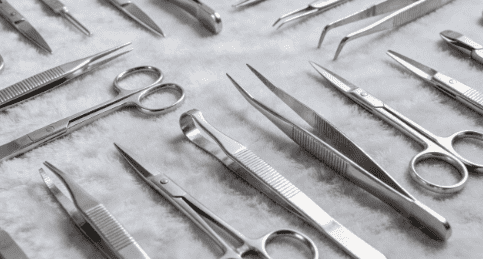
Medical devices, surgical instruments, and implants rely on precision and reliability for patient safety and performance. A tiny defect in a metal component can compromise an entire surgical procedure or device. That’s why medical investment castings have become the industry standard—they allow manufacturers to produce highly detailed, near-net-shape components with extremely tight tolerances.
Investment casting, also known as lost-wax casting, combines artistry and precision engineering, enabling medical manufacturers to achieve:
- Complex geometries impossible with sand casting
- Fine surface finishes suitable for sterilization
- Material flexibility, including stainless steel, cobalt-chromium, titanium, and specialty alloys
- Repeatable high-quality results for small or large production runs
According to industry data, over 60% of critical surgical instruments worldwide are now produced using investment casting techniques due to their consistency and reliability. With regulatory scrutiny increasing, understanding quality standards, material properties, and inspection methods is essential for medical manufacturers, distributors, and procurement specialists.
Understanding Medical Investment Castings
What Are Medical Investment Castings?
Medical investment castings are precision metal components produced using a wax pattern coated with a refractory ceramic shell. Once the wax is melted out, molten metal is poured in, forming highly accurate, detailed, and smooth components suitable for medical use.
Applications include:
- Surgical instruments such as forceps, clamps, and scalpels
- Orthopedic implants like hip, knee, and spinal components
- Dental implants and prosthetic devices
- Custom parts for medical machinery and diagnostic equipment
Advantages Over Other Casting Methods
- Dimensional precision: Achieves ±0.1–0.2 mm tolerance
- Surface quality: Ra 0.8–1.6 µm, often reducing polishing requirements
- Material versatility: Stainless steel, cobalt-chromium, titanium, aluminum, and copper alloys
- Flexibility: Supports both prototypes and large-scale production runs
Medical Investment Casting Materials and Standards
Stainless Steel 316L
- Corrosion-resistant and biocompatible
- Widely used in surgical instruments and small implants
- High fatigue strength ensures long-term reliability
Cobalt-Chromium Alloys
- Extremely high wear resistance
- Ideal for orthopedic implants
- Supports high-temperature sterilization without degradation
Titanium Alloys
- Lightweight yet strong
- Excellent biocompatibility and corrosion resistance
- Often used in dental and spinal implants
Specialty Alloys (Hastelloy, Monel, Cobalt-based)
- Used in niche medical applications requiring high strength and chemical resistance
- Handles aggressive sterilization chemicals and high-load scenarios
Material Properties Table
| Material | Tensile Strength (MPa) | Corrosion Resistance | Common Use |
|---|---|---|---|
| Stainless Steel 316L | 485 | Excellent | Instruments, implants |
| Cobalt-Chromium Alloy | 655 | Excellent | Orthopedic implants |
| Titanium Alloy | 550 | Superior | Implants, dental components |
| Hastelloy/Monel/Cobalt-based | 690–780 | Superior | Specialized medical components |
Key Quality Standards for Medical Investment Castings
Dimensional Accuracy and Tolerances
Tight tolerances ensure medical devices function correctly. Typical standards:
- Small components: ±0.1 mm
- Larger components: ±0.2 mm
Surface Finish
- Smooth surfaces reduce contamination and improve sterilization
- Ra 0.8–1.6 µm recommended for surgical instruments
- Polishing, passivation, or electropolishing can enhance corrosion resistance
Material Integrity
- Compliance with ASTM, ISO, and FDA standards is mandatory
- Mechanical properties including yield strength, hardness, and elongation must be verified
- Traceability for each batch is required for medical applications
Non-Destructive Testing (NDT)
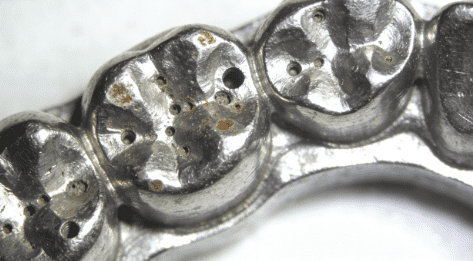
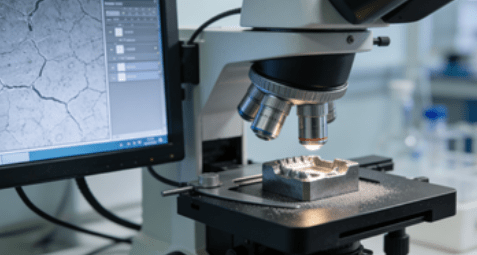
- X-ray inspection identifies internal porosity and inclusions
- Ultrasonic testing detects micro-cracks and structural weaknesses
- Dye penetrant testing identifies surface cracks
Step-by-Step Inspection Process
Visual Inspection
Look for surface defects such as:
- Porosity
- Oxidation or discoloration
- Surface cracks
- Incomplete fill areas
Dimensional Verification
- Use calipers, coordinate measuring machines (CMM), or laser scanners
- Ensure tolerances are within specified ranges
Mechanical Testing
- Hardness tests confirm material strength
- Tensile tests verify mechanical reliability
Advanced Inspection Techniques
- 3D scanning for complex geometries
- CT scanning for internal defects
- Load testing for functional stress simulation
Common Defects and Their Prevention
Porosity
- Caused by trapped air or gas during pouring
- Prevention: vacuum casting, proper wax density, degassing
Misruns or Incomplete Fill
- Occurs when metal solidifies before filling mold
- Prevention: optimized gating and pouring temperature control
Surface Oxidation
- Reaction of molten metal with oxygen
- Prevention: inert gas or vacuum casting environment
Comparing Medical Investment Casting With Sand Casting
| Feature | Investment Casting | Sand Casting |
|---|---|---|
| Tolerance | ±0.1–0.2 mm | ±0.5–1 mm |
| Surface Finish | Ra 0.8–1.6 µm | Ra 3–6 µm |
| Complex Geometry | High | Limited |
| Post-processing Required | Minimal | Extensive |
| Material Options | Wide | Limited |
Insight: Investment casting is superior for medical applications requiring precision, biocompatibility, and complex geometries.
Real-World Case Studies
Surgical Instruments
- Forceps and clamps with fine teeth patterns cast with ±0.1 mm tolerance
- Reduced post-processing by 30% compared to traditional methods
Orthopedic Implants
- Hip and knee prostheses produced using cobalt-chromium alloy
- Survived load tests up to 5,000 N cyclic stress, demonstrating durability
Dental Components
- Crowns and abutments produced with titanium alloys
- Wax patterns allow exact fit, reducing chairside adjustment time
Handling, Post-Processing, and Lifecycle Management
Handling Best Practices
- Store castings in controlled environments
- Avoid scratching or contamination during handling
- Maintain traceability with batch documentation
Post-Processing
- Deburring, polishing, passivation, or electropolishing
- Sterilization testing for surgical instruments
- Dimensional verification post-processing
Lifecycle Management
- Scheduled inspections and testing
- Proper storage to prevent oxidation or corrosion
- Record keeping for regulatory compliance
Cost and Efficiency Considerations
- High-quality investment castings may have a higher upfront cost ($150–$500 per small component)
- Reduced post-processing and precision ensures lower lifecycle costs
- Flexible production supports small-batch prototypes and large-scale production efficiently
FAQ
What makes medical investment castings preferred over sand casting?
They provide higher precision, better surface finish, and can produce complex geometries suitable for medical applications.
Which materials are most suitable for medical castings?
Stainless steel 316L, cobalt-chromium alloys, titanium alloys, and specialty biocompatible alloys.
How is quality ensured in medical investment castings?
Through dimensional checks, NDT methods, material testing, and compliance with ASTM, ISO, and FDA standards.
Can small-batch production meet high-quality standards?
Yes, investment casting is flexible enough to deliver consistent quality for both prototypes and mass production.
What are the common defects and how are they prevented?
Porosity, misruns, and surface oxidation; prevention includes vacuum casting, proper gating, and controlled atmosphere.
Choosing a Trusted Supplier
For high-performance, high-precision medical investment castings, partnering with an experienced manufacturer is crucial.
Shanghai Leierwo Industry & Trade Co., Ltd.:
- Founded in June 2007, factory in Taixing City, Jiangsu Province
- Covers 23,789.83 m², annual output over 100 million yuan
- Exports over 95% globally, including Europe, USA, Japan
- Specializes in carbon steel, alloy steel, stainless steel, and special alloys
- Serves pumps, valves, ships, machinery, automotive, aerospace, medical, energy, and petrochemical sectors
- Offers customized solutions for high-precision, complex medical components
Contact us today to discuss medical investment castings that meet the highest quality and precision standards.
Product Categories
- Valve Parts
- Water Pump Parts
- Bearing Box Parts
- Die Casting Parts
- Stainless Steel Pump Products
- Cast Iron Pump Products
- Valve Parts For Automobile Use
- Auto Parts
- Valve Parts For Civil Use
- Vacuum Pump Parts KF

 English
  Spanish
  Arabic
  Malay
Malay  German