
Why Carbon Fiber is a Game-Changer
Welcome to My Blog!
I’m thrilled to have you here! Before we dive into the content, I’d love for you to join me on my social media platforms. It’s where I share extra insights, connect with our amazing community, and keep you updated on the latest news. Here’s how you can stay connected:
📘 Facebook: Shanghai Leierwo Industry Trade Co., Ltd.
Now, let’s embark on this journey together! I hope you find the content here not only insightful but also inspiring and valuable. Let’s get started!
Table of Contents
In the rapidly evolving landscape of advanced materials, carbon fiber has emerged as one of the most transformative innovations of the 21st century. Its combination of strength, lightweight characteristics, and versatility has made it indispensable across a wide range of industries — from aerospace and automotive to sports equipment and 3D printing. But what exactly makes carbon fiber so revolutionary? How is it made, and why is its impact so profound?
This comprehensive article explores the fundamentals of carbon fiber, its manufacturing process, key applications, and why it continues to redefine the limits of design and performance. With expert insights and real-world examples, you will gain a deep understanding of how carbon fiber is shaping the future of manufacturing and engineering.
Introduction
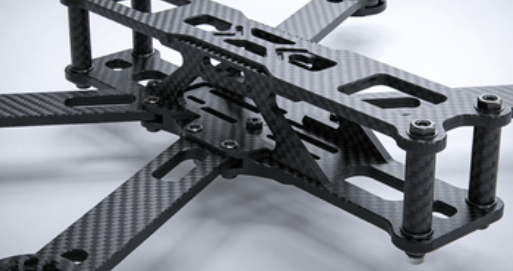
Carbon fiber refers to a material composed of extremely thin fibers — typically around 5–10 micrometers in diameter — that are primarily made of carbon atoms bonded together in microscopic crystalline structures. These fibers can be woven into fabrics or combined with resins to form composite materials with exceptional mechanical properties.
Unlike traditional materials such as steel or aluminum, carbon fiber offers an extraordinary strength-to-weight ratio. This means that components made from carbon fiber can be significantly lighter while maintaining, or even exceeding, the strength of metal counterparts. This unique combination has positioned carbon fiber as a true game-changer in performance-driven sectors.
To fully appreciate the impact of carbon fiber, it is important to examine what makes it structurally unique, how it is produced, and how its properties are leveraged in cutting-edge applications.
What Is Carbon Fiber?
At its core, carbon fiber is a polymer-based material that undergoes a transformation process to achieve its characteristic mechanical properties. The fibers themselves are composed mostly of carbon atoms arranged in long chains, making them rigid and capable of bearing substantial loads.
One of the key reasons carbon fiber behaves differently from traditional fibers or metals is due to its internal microstructure. The carbon atoms form strong covalent bonds, creating tightly packed crystalline regions. These regions contribute to the fiber’s high tensile strength — a measure of how much pulling force a material can withstand before breaking.
The typical composition of carbon fiber is:
- Carbon content: 90% or higher
- Other elements: Oxygen, hydrogen, nitrogen, sulfur in small amounts
The high carbon content and carefully controlled manufacturing process give carbon fiber its exceptional properties.
Key Properties of Carbon Fiber
Carbon fiber exhibits a range of material properties that differentiate it from conventional engineering materials. Some of the most notable properties include:
- High tensile strength: Carbon fiber’s tensile strength can exceed 4,000 MPa in high-grade materials.
- Low density: With a density around 1.6 g/cm³, it is much lighter than steel (7.85 g/cm³) or aluminum (2.7 g/cm³).
- High stiffness: Carbon fiber has a high modulus, meaning it resists deformation under load.
- Corrosion resistance: Unlike metals, carbon fiber does not corrode when exposed to environmental conditions.
- Thermal stability: Carbon fiber maintains structural integrity at elevated temperatures, although the resin matrix often limits thermal performance.
These properties form the basis for carbon fiber’s widespread adoption in high-performance applications.
How Is Carbon Fiber Made?
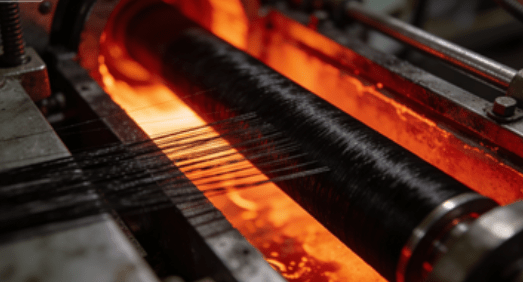
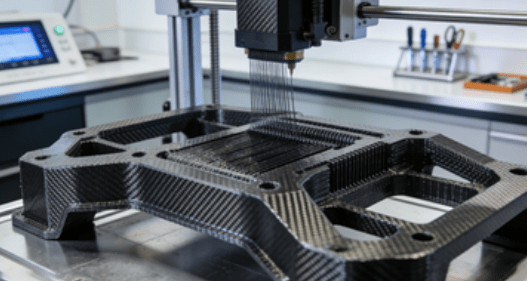
Understanding how carbon fiber is made provides insight into its performance and cost structure. The manufacturing process is both technically complex and energy-intensive, involving several stages that transform precursor materials into high-strength fibers.
Precursor Selection
The most common precursor for carbon fiber production is polyacrylonitrile (PAN), which accounts for approximately 90% of all carbon fiber manufacturing worldwide. Other precursors include pitch and rayon, though these are less common due to performance and cost considerations.
Stabilization
In the first major processing step, the PAN precursor is stabilized in a controlled oxygen environment at temperatures between 200°C and 300°C. During this phase, the chemical structure changes, making the fibers thermally stable and ready for carbonization.
Carbonization
Carbonization is the central step in carbon fiber production. Stabilized fibers are heated to temperatures between 1,000°C and 3,000°C in an inert atmosphere (typically nitrogen). This process removes non-carbon atoms and aligns the carbon atoms into tightly bonded crystalline structures. As a result, the fibers gain significant strength and stiffness.
Surface Treatment
After carbonization, fibers undergo surface treatment to improve adhesion with resins and matrices. This typically involves oxidizing the fiber surface to introduce functional groups that enhance bonding with composite materials.
Sizing
Finally, fibers are coated with a protective layer called sizing. This helps protect the delicate fibers during handling, weaving, and composite manufacturing. The sizing also improves compatibility with specific resin systems.
The total manufacturing process results in carbon fiber that can be further processed into fabrics, tow (bundles of fibers), or prepreg materials (pre-impregnated with resin).
Carbon Fiber Composite Materials and Their Forms
Carbon fiber rarely exists in isolation; it is most often used in combination with polymer resins to form composite materials. These composites leverage the strength of carbon fiber and the flexibility of polymer matrices to create materials that are both strong and versatile.
Some common forms include:
- Carbon fiber fabrics: Woven cloth used for layup in composite manufacturing.
- Tow and roving: Bundles of continuous carbon fibers used in filament winding.
- Prepreg: Carbon fiber pre-impregnated with resin, ready for molding.
- Chopped fiber composites: Short fibers mixed with resins for injection molding.
Each form has specific advantages and is chosen based on application requirements.
Key Applications of Carbon Fiber
The strength-to-weight advantages of carbon fiber make it ideal for applications where performance and efficiency are critical. Below is a comprehensive comparison of how different carbon fiber materials perform in various industries:
| Application Sector | Typical Use Case | Key Performance Benefit | Relative Cost | Typical Material Form |
|---|---|---|---|---|
| Aerospace | Structural components, fuselage, wing spars | High strength-to-weight, fatigue resistance | High | Prepreg, woven |
| Automotive | Body panels, chassis components | Weight reduction, improved efficiency | Moderate–High | Chopped composites, prepreg |
| Sports Equipment | Bicycles, racquets, helmets | Enhanced stiffness and strength | Moderate | Woven, tow |
| Wind Energy | Turbine blades | Lightweight and durable | High | Prepreg, woven |
| Marine | Hulls, masts | Corrosion resistance and strength | Moderate | Woven |
| 3D Printing | Reinforced filaments, printed parts | Custom shapes, performance tuning | Emerging | Filament, pellet |
This table highlights how carbon fiber’s advantages translate into measurable benefits across industries, from aerospace to emerging 3D printing applications.
Carbon Fiber in 3D Printing
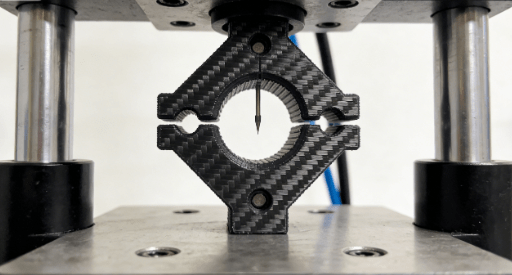
One of the most exciting developments in advanced manufacturing is the integration of carbon fiber into 3D printing. Traditional 3D printing materials like PLA or ABS offer ease of use but fall short in performance. By incorporating carbon fiber, manufacturers can produce parts that are not only lightweight but also significantly stronger and more rigid.
Carbon Fiber Filaments
Carbon fiber filaments are composite materials typically made by blending short carbon fibers with a base polymer such as nylon, PLA, or ABS. These filaments can be used in fused deposition modeling (FDM) printers to produce parts with enhanced mechanical properties.
According to industry data, carbon fiber reinforced filaments can exhibit:
- Up to 2–4 times higher stiffness than unreinforced polymers
- Significant improvements in dimensional stability
- Reduced warping during printing
These benefits make carbon fiber filaments ideal for functional prototypes, end-use parts, and tooling.
Continuous Carbon Fiber Printing
Beyond short fiber filaments, advanced 3D printing systems now support continuous carbon fiber reinforcement. In this technique, continuous strands of carbon fiber are embedded within the printed layers, dramatically increasing strength and stiffness. Continuous reinforcement can yield parts with properties approaching those of traditional composite laminates.
Engineers in aerospace and automotive sectors are increasingly experimenting with continuous carbon fiber printing for components that need exceptional performance under load.
Industrial and Consumer Applications
Carbon fiber 3D printing is being adopted for:
- Custom jigs and fixtures for manufacturing lines
- Prototyping functional components that require high stiffness
- Small-batch production parts with performance demands
- Lightweight structural elements in robotics and automation
Experts suggest that carbon fiber’s integration into additive manufacturing could unlock entirely new design possibilities, especially for complex geometries that are difficult or impossible to produce with traditional composites.
Advantages of Carbon Fiber
The widespread adoption of carbon fiber is driven by multiple advantages that set it apart from traditional materials.
Exceptional Strength-to-Weight Ratio
One of the most quoted advantages of carbon fiber is its ability to deliver high strength at a fraction of the weight of metal alternatives. For example, carbon fiber composites can be five times stronger than steel yet one-third the weight, significantly improving performance in weight-sensitive applications.
Fatigue and Corrosion Resistance
Carbon fiber composites exhibit excellent fatigue resistance, meaning they maintain structural integrity over repeated loading cycles. Unlike metals, they also do not rust, making them ideal for use in harsh environments.
Design Flexibility
Carbon fiber can be molded into complex shapes without the need for expensive tooling, enabling designers to explore new geometries that improve performance or reduce part count.
Thermal Stability
Carbon fiber maintains its mechanical properties across a wide range of temperatures, making it suitable for applications where thermal distortion is a concern.
Long-Term Durability
Parts made with carbon fiber composites have a long service life and require minimal maintenance compared with traditional materials.
Challenges and Considerations
Despite its advantages, carbon fiber also presents challenges that engineers and manufacturers must address.
Cost Factors
The primary limitation of carbon fiber is cost. The complex manufacturing process and energy-intensive production contribute to higher material prices compared with metals or traditional polymers. This often limits its use to applications where performance justifies the expense.
Manufacturing Complexity
Working with carbon fiber requires specialized skills and equipment, especially when producing high-performance composites. Proper layup, curing, and quality control are essential to achieve the desired mechanical properties.
Recycling and Sustainability
Recycling carbon fiber composites remains difficult due to the strong bonding between fibers and resin matrices. While research into recycling methods continues, current solutions are not yet widespread.
Design and Simulation Requirements
Designing with carbon fiber often requires advanced simulation tools to accurately predict performance. The anisotropic nature of carbon fiber — meaning properties vary depending on direction — adds complexity to structural analysis.
Conclusion
Carbon fiber is truly a game-changer in advanced materials. Its combination of high strength-to-weight ratio, corrosion resistance, design flexibility, and thermal stability has transformed industries ranging from aerospace and automotive to sports equipment and additive manufacturing. As 3D printing continues to evolve, carbon fiber’s role is expanding, enabling the production of parts that are both lightweight and high-performance.
The ongoing integration of carbon fiber with emerging technologies like continuous reinforcement and high-performance composites suggests that we are only at the beginning of its potential. For engineers, designers, and manufacturers seeking to push the boundaries of what is possible, carbon fiber represents a material that will continue to shape the future of engineering.
FAQ
Q1: What makes carbon fiber superior to traditional materials?
A1: Carbon fiber combines high tensile strength with low density, offering superior strength-to-weight ratios compared with metals like steel and aluminum. It also resists corrosion and fatigue.
Q2: Can carbon fiber be printed using standard 3D printers?
A2: Standard 3D printers can use carbon fiber reinforced filaments, but high-performance applications may require printers capable of continuous fiber reinforcement.
Q3: Why is carbon fiber expensive?
A3: The manufacturing process is energy-intensive and complex, involving high-temperature carbonization and precise control, which increases production costs.
Q4: Is carbon fiber recyclable?
A4: Recycling carbon fiber composites is challenging due to the strong bond between fiber and resin. Research is ongoing, but widespread recycling methods are still limited.
Q5: Where is carbon fiber most commonly used?
A5: Aerospace, automotive, sports equipment, marine, and emerging 3D printing applications are among the most common sectors using carbon fiber.
Product Categories
- Valve Parts
- Water Pump Parts
- Bearing Box Parts
- Die Casting Parts
- Stainless Steel Pump Products
- Cast Iron Pump Products
- Valve Parts For Automobile Use
- Auto Parts
- Valve Parts For Civil Use
- Vacuum Pump Parts KF

Let’s start your next project!
Start Your Project with Leierwo
1. Submit Your Inquiry
2. Cost Calculation
3. Start Production
4. Arrange Delivery
FAQ
Yes, we have extensive experience in international trade and can assist customers with export customs clearance and shipping arrangements. We offer various trade terms such as FOB, CIF, and DDP to accommodate different logistics needs.We accept various international payment methods, including T/T (Telegraphic Transfer), wire transfer, and Letter of Credit (L/C). Payment terms can be discussed with our sales team.
By partnering with Leierwo, you can enjoy competitive pricing and superior quality compared to other suppliers. Additionally, we offer a one-stop solution to deliver finished parts, including CNC machining and surface treatment, ensuring a seamless production process.
We have advanced casting equipment and strict quality control systems. Our monthly production capacity is substantial, and we can manufacture products based on customer-provided drawings or samples. We accept both small trial orders and large-scale production.
Our products comply with international standards such as ASTM, AISI, DIN, and JIS. We can provide material test reports and relevant certifications to ensure product quality meets customer requirements.
We strictly follow the ISO 9001 quality management system and conduct multiple inspections throughout the production process, including spectrographic analysis, X-ray testing, ultrasonic testing, and dimensional measurements. These quality control measures guarantee that our castings meet the highest standards.
Our MOQ depends on the product type and complexity, However, we are flexible and open to discussing your specific needs.
Our standard production lead time is 4-6 weeks, depending on order quantity and product complexity. We strive to shorten delivery times to meet customer demands.
Yes, we can provide samples for quality inspection. Sample costs and shipping fees can be negotiated, and sample fees may be refunded upon placing a formal order.
 English
  Spanish
  Arabic
  Malay
Malay  German